Projects

MASTERS CAPSTONE · CONTENT STRATEGY
Museum Exhibit Digitization
Museum Exhibit Digitization
Architecting a sustainable behind-the-scenes video strategy that helps a small museum's curatorial work outlive its exhibits.
Architecting a sustainable behind-the-scenes video strategy that helps a small museum's curatorial work outlive its exhibits.
Modest problem space
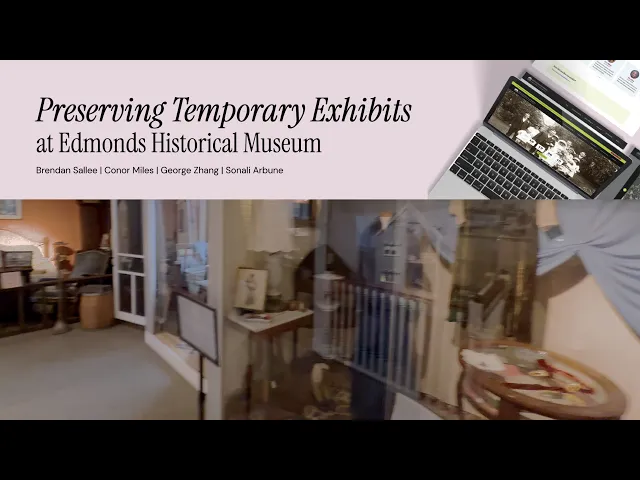
Our capstone team partnered with the Edmonds Historical Museum, a small nonprofit museum just north of the Seattle metro area. Each museum exhibit represents months of work by curators, staff, and volunteers. However, as in many smaller museums, space is tight. Temporary exhibits need to rotate out every 3-6 months, and once dismantled and re-shelved, the museum loses the incredible stories behind their creation. Edmonds Historical Museum lacked a way to catalogue and preserve their temporary exhibits, and its limited staff, budget, and technical infrastructure ruled out any heavy digital-recreation approach.
Our capstone team partnered with the Edmonds Historical Museum, a small nonprofit museum just north of the Seattle metro area. Each museum exhibit represents months of work by curators, staff, and volunteers. However, as in many smaller museums, space is tight. Temporary exhibits need to rotate out every 3-6 months, and once dismantled and re-shelved, the museum loses the incredible stories behind their creation. Edmonds Historical Museum lacked a way to catalogue and preserve their temporary exhibits, and its limited staff, budget, and technical infrastructure ruled out any heavy digital-recreation approach.

Informed scrappiness
To find a sustainable alternative, we ran discovery research including SME interviews, a museum walkthrough, a participatory mapping activity, and a literature review. That research pointed us away from high-fidelity digital replicas, which were both resource-prohibitive for a museum with one full-time staff member and unconvincing to visitors, who were more drawn to the stories behind an exhibit than a 1:1 recreation of it. That insight led us to pivot toward a lower-lift, higher-impact concept: short-form behind-the-scenes video content paired with an updated exhibit archive on the museum's website.
To find a sustainable alternative, we ran discovery research including SME interviews, a museum walkthrough, a participatory mapping activity, and a literature review. That research pointed us away from high-fidelity digital replicas, which were both resource-prohibitive for a museum with one full-time staff member and unconvincing to visitors, who were more drawn to the stories behind an exhibit than a 1:1 recreation of it. That insight led us to pivot toward a lower-lift, higher-impact concept: short-form behind-the-scenes video content paired with an updated exhibit archive on the museum's website.

Direct to video
Direct to video
I led video and filmmaking production, translating our concept into something the museum could realistically sustain after our capstone concluded. I developed storyboard templates that break each video into individually shootable shots, then used them to produce exemplar videos on-site with the museum's collections manager—filming the same artifact once with a professional camera and once on an iPhone, to prove smartphone-only production was viable for a team with no dedicated AV equipment or budget.
I led video and filmmaking production, translating our concept into something the museum could realistically sustain after our capstone concluded. I developed storyboard templates that break each video into individually shootable shots, then used them to produce exemplar videos on-site with the museum's collections manager—filming the same artifact once with a professional camera and once on an iPhone, to prove smartphone-only production was viable for a team with no dedicated AV equipment or budget.

Designing for longevity
Because our team was graduating and handing off the project, sustainability shaped every decision. We delivered a content guide, storyboard templates, exemplar videos, and website wireframes designed for volunteers or interns without filmmaking experience. Together, those materials reduced the knowledge and equipment required for the museum to continue producing content after our involvement ended.
Because our team was graduating and handing off the project, sustainability shaped every decision. We delivered a content guide, storyboard templates, exemplar videos, and website wireframes designed for volunteers or interns without filmmaking experience. Together, those materials reduced the knowledge and equipment required for the museum to continue producing content after our involvement ended.

Challenges and shortcomings
Mixed methods. Our museum-visitor map activity and member survey, run before we'd committed to a concrete concept, yielded limited and somewhat unfocused data; we hadn't clearly defined what we needed to learn from visitors. This data did little to help us home in on a medium and format for our solution, requiring further research.
Mixed methods. Our museum-visitor map activity and member survey, run before we'd committed to a concrete concept, yielded limited and somewhat unfocused data; we hadn't clearly defined what we needed to learn from visitors. This data did little to help us home in on a medium and format for our solution, requiring further research.
Order of operations. We assumed visitors, as end-users, should be our primary research focus, but that assumption cost us time we later needed for stakeholder and SME conversations that turned out to be more decision-shaping. Museum capacity constraints mattered more to what we could feasibly design—something we only realized during research synthesis.
Order of operations. We assumed visitors, as end-users, should be our primary research focus, but that assumption cost us time we later needed for stakeholder and SME conversations that turned out to be more decision-shaping. Museum capacity constraints mattered more to what we could feasibly design—something we only realized during research synthesis.
Back to basics. Work from prior capstone teams rarely survived past the end of the quarter, due to thin documentation and staff/ volunteer turnover. This emphasized the need for thorough walkthroughs, set the tone for a longevity-focused strategy, and ruled out some more ambitious design ideas early on.
Back to basics. Work from prior capstone teams rarely survived past the end of the quarter, due to thin documentation and staff/ volunteer turnover. This emphasized the need for thorough walkthroughs, set the tone for a longevity-focused strategy, and ruled out some more ambitious design ideas early on.